Gold Watch
The gold watch discovered in the pyjama pocket of the murdered Samuel Edward Ratchett is one of the most deliberately misleading pieces of evidence in the case. Its dented case and hands stopped at a quarter past one initially seemed to provide a precise timestamp for the murder, but Hercule Poirot's analysis reveals it as a carefully planted false clue, part of the elaborate conspiracy by the twelve passengers who formed a self-appointed jury to execute Ratchett for the kidnapping and murder of Daisy Armstrong.
Discovery and Initial Interpretation
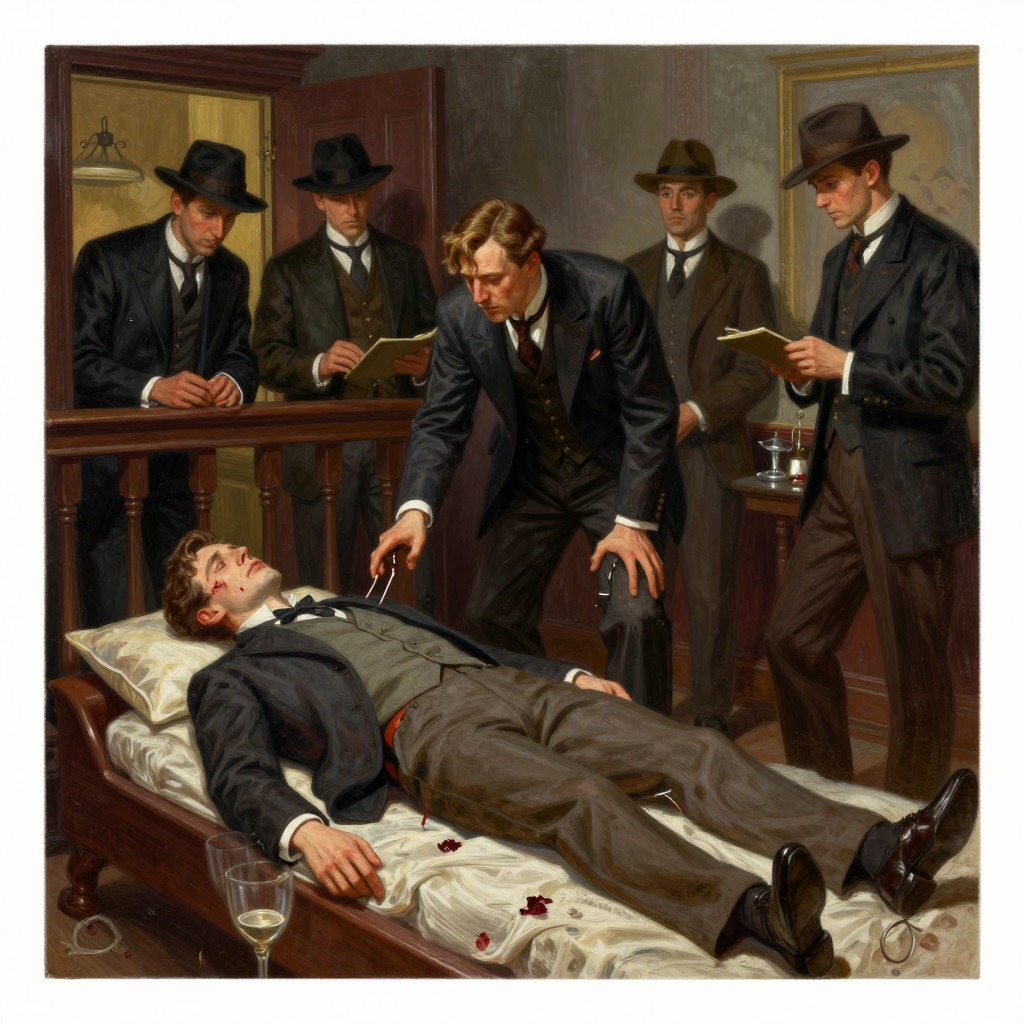
Dr. Constantine, the Greek physician who examined the body, found the watch in the breast pocket of Ratchett's pyjama jacket after unbuttoning the garment and throwing it back. The case was "dented savagely," and the hands pointed to a quarter past one. Constantine immediately seized on this as confirmation of his own medical estimate that death occurred between midnight and two in the morning, probably around one o'clock. "Eh bien, here is confirmation. A quarter past one. That was the hour of the crime," he declared eagerly. M. Bouc, the director of the Compagnie Internationale des Wagons Lits, also accepted the watch as definitive proof, brightening at the mention of it and saying, "That seems to give us the time of the crime very exactly."
Poirot's Skepticism and Analysis
Poirot, however, responded to Constantine's enthusiasm with a noncommittal "It is possible, yes. It is certainly possible," and the doctor noticed that Poirot seemed troubled rather than satisfied. The detective's doubts were rooted in the watch's placement. He later pointed out that the watch was found in Ratchett's pyjama pocket, "a singularly uncomfortable and unlikely place to keep one's watch, especially as there is a watch 'hook' provided just by the head of the bed." This observation led Poirot to conclude that the watch had been "deliberately placed in the pocket—faked." The crime, therefore, was not committed at a quarter past one. The watch was a planted clue, not an accidental record of the moment of death.
The Watch in Poirot's Two Solutions
In his first, deliberately false solution presented to the passengers, Poirot offered a simple explanation for the watch's discrepancy: Ratchett had failed to set his watch back an hour at the frontier, so it still registered Eastern European time, making the actual time of stabbing a quarter past twelve, not a quarter past one. This was a red herring, designed to test the conspirators and to provide a plausible alternative narrative for the official police. In his second, true solution, Poirot revealed that the watch was part of a larger scheme to confuse the investigation. The conspirators had staged the entire sequence of events—the cry in the night, the French phrase spoken to the conductor, the dented watch—to create a false timeline. The watch's hands were set to 1:15 because that was the time the intruder was meant to have left the scene, and anyone with a solid alibi for that hour would appear innocent. The watch was a deliberate misdirection, not a genuine clue.
Significance and Thematic Role
The gold watch exemplifies the novel's central theme of justice versus legal procedure. It is a physical object that, in a conventional detective story, would provide a reliable fact; here, it is a manufactured piece of evidence, as false as the threatening letters and the mythical small dark man. The conspirators, having seen Ratchett escape the legal system through technicalities, use the same kind of artifice to protect themselves. The watch's dented case and stopped hands are a metaphor for the way the conspirators have bent the truth to serve their own form of justice. Poirot's ability to see through this deception—to question why a watch would be kept in a pyjama pocket rather than on the bedside hook—demonstrates his method of relying on psychology and logic over surface appearances. The watch ultimately becomes a symbol of the case's complexity: what seems to be the most straightforward piece of evidence is, in fact, the most carefully constructed lie.